
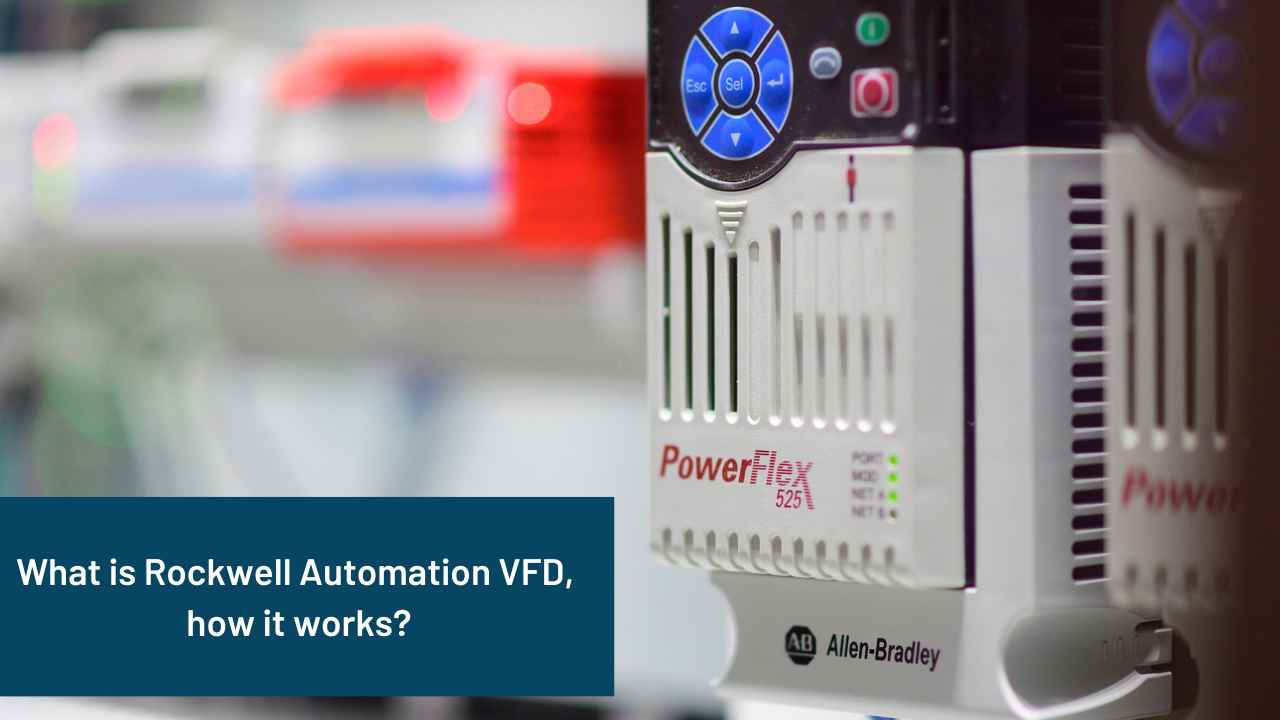
Rockwell Automation VFDs are a type of motor control drive manufactured by the well-known industrial automation company Rockwell Automation (Variable Frequency Drives). VFDs are electronic devices that control the speed, torque, and acceleration/deceleration of electric motors by varying the voltage and frequency applied to the motor.
The following describes how Rockwell Automation VFDs typically operate:
1. Input Power:
The VFD is powered by the primary power source, which is often AC (Alternating Current) power.
- Three-Phase Input: The majority of VFDs are designed to accept three-phase AC power as an input. Applications involving industrial motor control profit from three-phase electricity’s more efficient and balanced power delivery. The voltage and frequency of the three-phase input may vary depending on the specific VFD type and local regulations. Typical configurations are 200-240V, 380-480V, or 500-690V at 50 or 60 Hz.
Read: Allen Bradley PowerFlex 4M AC drives
2. Rectification:
The incoming AC power is initially converted into DC (Direct Current) via the rectifier circuit in the VFD. In this rectification process, the alternating current is converted to direct current using diodes.
- AC Input: The VFD is typically powered by an AC three-phase power source.
- Converter Stage: The AC input power is first condition in a converter stage. Typically, this phase consists of diodes that allow the current to flow in one direction in order to convert the AC power into a pulsating DC waveform. This step is known as a diode bridge.
- DC Bus: A DC bus capacitor is then used to filter and smooth the pulsing DC voltage. By preserving a largely steady DC voltage, the capacitor lessens any ripples or variations.
3. DC Bus:
The rectified DC power is stored in a DC bus capacitor, which produces a constant DC voltage supply.
- Converter Stage: By sending it via a converter step—typically a diode bridge—the AC input power is transformed into a pulsating DC waveform. This diode bridge rectifier converts the alternating current to unidirectional current.
- Filtering: The pulsating DC voltage at the converter stage has ripples or oscillations in it. To control the DC voltage and minimise these ripples, a filtering process is employed. This involves use a DC bus capacitor as a means of energy storage. By charging during periods of high voltage and discharging during periods of low voltage, the capacitor helps to maintain a more steady DC voltage.
4. Inverter Stage:
The inverter stage must convert the DC power from the DC bus into a variable frequency AC power output. The inverter swiftly toggles the DC voltage on and off, creating a pulsed waveform. For this, Insulated Gate Bipolar Transistors (IGBTs), a type of power electronic switch, are usually utilised.
- AC Output: The motor receives a pulsed waveform from the inverter switches. To change the torque and speed of the motor, the VFD modifies the voltage and frequency of the pulsed waveform. The regulated DC voltage from the DC bus is essentially converted into an AC waveform suitable for driving the motor by the inverter step.
- Control Algorithms: The control system of the VFD continually checks many parameters, such as motor speed, voltage, and current, to maintain proper motor operating and alter the PWM signals. Control algorithms that rely on external inputs or user-defined setpoints regulate the motor speed.
Check: Allen Bradley AC drives
5. Pulse Width Modulation (PWM):
The VFD uses the pulse width modulation (PWM) technology to control the output voltage and frequency. PWM involves varying the width (on-time) of the pulses in the pulsed waveform while keeping the frequency constant. Through adjusting the pulses’ on-time, the VFD controls the effective voltage and frequency applied to the motor.
- Reference Signal: A reference signal indicating the desired torque or speed for the motor is sent to the VFD. An operator interface, a control system, or other outside sources might be the source of this signal.
- Comparison: The VFD’s control circuit compares sensor-measured motor speed or torque feedback to the reference signal. This comparison determines the output waveform alterations that need to be made.
6. Motor Control:
The variable frequency AC electrical output from the VFD is subsequently sent to the motor. By adjusting the frequency and voltage, the VFD accurately controls the motor’s speed, torque, and acceleration/deceleration. This enables accurate control and efficient operation of a wide range of industrial applications.
- Speed Control: The control system of the VFD receives a speed reference signal that is in line with the necessary motor speed. This signal can be supplied by an external control system or set via an operator interface. The control system uses speed feedback sensors to continually compare the motor speed reference signal with the actual motor speed.
7. Control and Programming:
Rockwell Automation VFDs come with control logic and programming. They often feature keypads, human-machine interfaces (HMIs), or software tools as interfaces for troubleshooting, performance monitoring, and programming and tweaking drive settings.
- Open-Loop Control: The VFD, which operates at a preset frequency, receives no direct feedback from the motor when in this mode. It works well in simple applications when controlling speed is not the main concern.
- Closed-Loop Control: During closed-loop control, speed sensors or encoders on the motor shaft provide feedback to the VFD. This feedback is used to regulate and maintain the motor speed at the appropriate setpoint.
By changing the output frequency and voltage, Rockwell Automation VFDs offer precise motor speed control, resulting in energy savings, improved process control, and less mechanical stress on equipment.
In the area of Process and Power Automation, Asteam Techno Solutions Pvt. Ltd. is a top-tier and favoured supplier of solutions for all types of industrial automation needs. Asteam Techno Solutions was founded in 2017 and is an ISO 9001: 2015 certified company. It offers complete integration under one roof and has its Design, Manufacturing, and Repair facility located in Surat, Gujarat, India.