
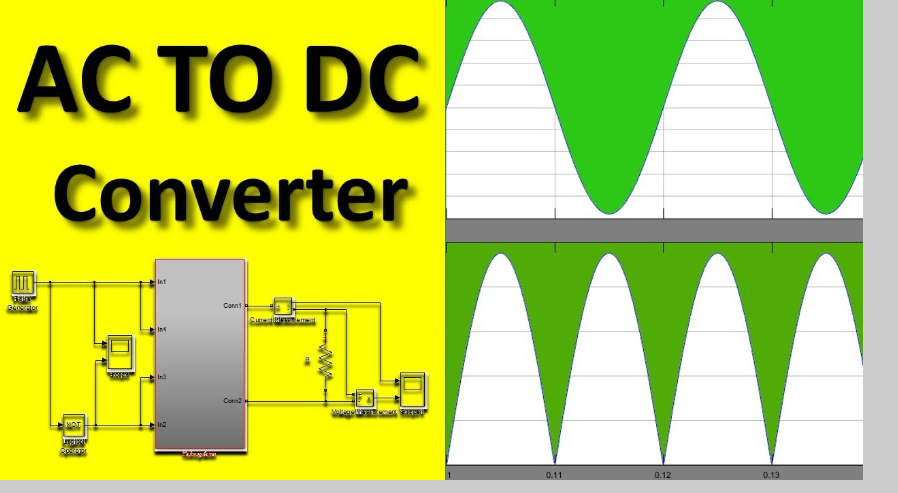
In a world filled with electronic devices and gadgets, from smartphones and laptops to kitchen appliances and industrial machinery, AC to DC conversion is an unsung hero that enables these technologies to function seamlessly. In this article, we’ll delve into the fascinating realm of AC to DC conversion, exploring its significance, underlying principles, and real-world applications.
Understanding the Basics
Before we dive deeper into AC to DC conversion, let’s establish a fundamental understanding of the two types of electrical current involved:
AC (Alternating Current): AC is the type of electrical current that flows in two directions, oscillating back and forth in a wave-like pattern. It’s the kind of electricity that comes from power grids and wall outlets in homes and businesses.
DC (Direct Current): DC, on the other hand, flows steadily in one direction, like a river. Most electronic devices and circuits rely on DC voltage to operate.
The Need for Conversion
So, why do we need to convert AC to DC? Here are some key reasons:
-
Stability: Many electronic components and circuits require a steady supply of DC voltage to operate reliably. AC voltage, with its constant fluctuation, is unsuitable for these applications.
-
Compatibility: Most electronic devices, from microchips to LEDs, are designed to work with DC voltage. Converting AC to DC ensures compatibility with these components.
-
Efficiency: Several electronic components, such as transistors and diodes, operate more efficiently on DC power.
Methods of AC to DC Conversion
Several methods are employed to convert AC to DC, each with its own characteristics and applications:
1. Single Diode Half-Wave Rectifier
-
Operation: The simplest form of AC to DC conversion, it uses a single diode to allow only one-half of the AC waveform to pass through, resulting in pulsating DC voltage.
-
Efficiency: Relatively low efficiency due to the loss of half of the input waveform.
2. Full-Wave Rectifier
-
Operation: Converts both the positive and negative halves of the AC waveform into DC using a bridge rectifier circuit composed of diodes.
-
Efficiency: Higher efficiency compared to half-wave rectifiers.
3. Bridge Rectifier
-
Operation: This configuration uses four diodes arranged in a bridge to rectify the entire AC waveform. It produces a smoother DC output.
-
Efficiency: Efficient and commonly used in various applications.
4. Center-Tapped Transformer Full-Wave Rectifier
-
Operation: A center-tapped transformer splits the AC waveform into two halves, and two diodes rectify each half. This results in full-wave rectification.
-
Efficiency: Offers good efficiency and is often used in power supplies.
5. Switching Power Supply (SMPS)
-
Operation: SMPSs use high-frequency switching to convert AC to DC. They are versatile and often incorporate features like voltage regulation and noise filtering.
-
Efficiency: High efficiency and compact size, suitable for various applications.
6. Linear Power Supply
-
Operation: Linear power supplies use a transformer, rectification, and regulation to provide a stable DC output.
-
Efficiency: Generally less efficient compared to SMPS but preferred for some specific applications.
7. Uninterruptible Power Supply (UPS)
-
Operation: A UPS includes an AC to DC conversion stage, typically using a bridge rectifier and a battery, to provide backup power during AC mains failure.
-
Efficiency: Efficiency varies depending on the UPS type and design.
Applications of AC to DC Conversion
AC to DC conversion is ubiquitous in our daily lives and is used in a wide range of applications, including:
-
Consumer Electronics: Charging your smartphone, running your laptop, and powering your LED TV all involve AC to DC conversion.
-
Power Adapters: The small adapters that come with laptops and other portable devices are essentially AC to DC converters.
-
Industrial Machinery: Manufacturing equipment often requires precise DC power for reliable operation.
-
Renewable Energy Systems: Solar panels and wind turbines generate DC power, which needs to be converted to AC for use in homes and the electrical grid.
-
Electric Vehicles: EV chargers use AC to DC conversion to charge the batteries in electric vehicles.
-
Telecommunications: Cell towers and communication equipment rely on AC to DC conversion for power.
Conclusion
AC to DC conversion is a fundamental process that powers the electronic devices and systems we rely on daily. Understanding the different methods and applications of AC to DC conversion helps us appreciate its significance in our increasingly electrified world. As technology continues to advance, AC to DC converters will remain indispensable, ensuring a steady supply of power to fuel our modern way of life.